
Mold Questions, Answered — Kansas City
Every Question We Get, Answered the Same Way We'd Answer It on the Phone.
Below are the questions we hear most, from “what causes mold” to “how much does this cost.” Each answer stands on its own — no need to read the whole page to understand any single one.
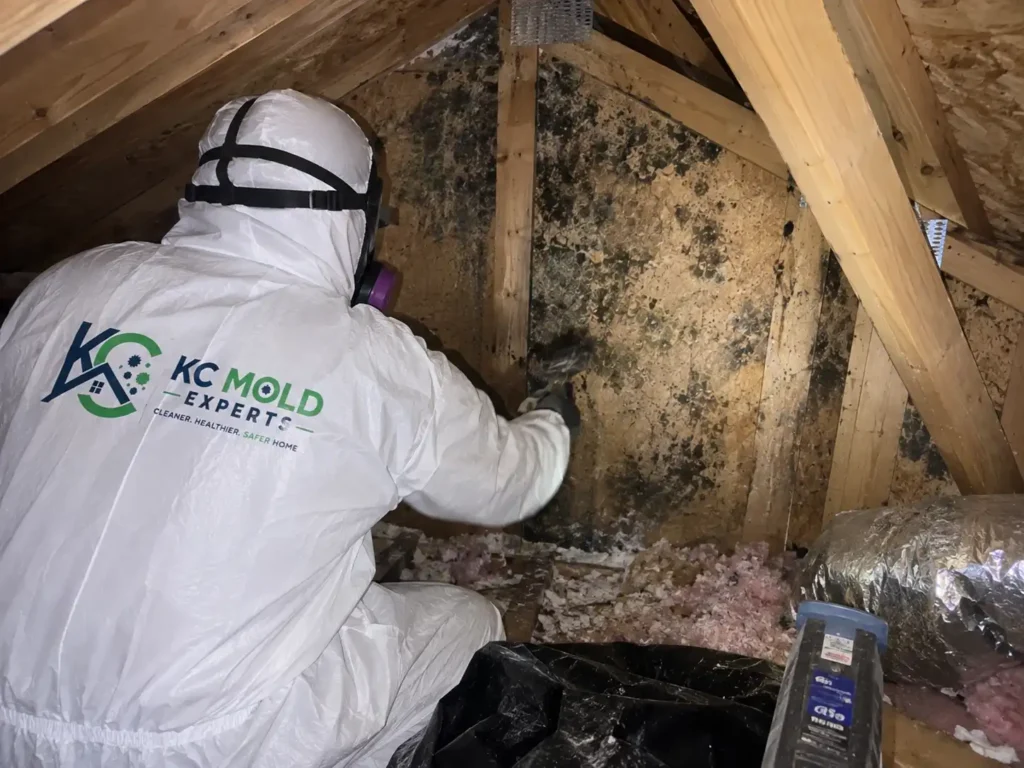
General Mold Questions
Mold is a type of fungus that grows in multicellular filaments called hyphae, reproducing through airborne spores. It exists naturally in both outdoor and indoor air at low levels and only becomes a problem when it finds a damp surface to colonize indoors. Mold spores are present in essentially all indoor air, so the goal of remediation is bringing levels back to a normal range, not eliminating spores entirely — no reputable company can promise a permanently mold-free environment.
Mold needs three things to grow: moisture, an organic food source (drywall paper, wood, dust), and time — typically 24 to 48 hours of sustained dampness. Common causes include leaks, high humidity, poor ventilation, and flooding that wasn’t fully dried. If you’re seeing mold with no obvious water source, KC Mold Experts can identify hidden moisture using thermal imaging during an inspection. This applies to indoor growth specifically; outdoor mold on siding or mulch is a separate, generally lower-concern issue.
Mildew is a surface-level fungus that typically grows flat and white or gray on damp surfaces like shower tile, while mold tends to be darker, fuzzier, and can penetrate more deeply into porous materials. Mildew is usually easier to clean with a household cleaner, while mold often requires more targeted removal, especially on porous materials. This distinction is about growth pattern and depth, not species — some mold species can also present as flat, mildew-like growth in early stages, so appearance alone isn’t a reliable way to tell them apart.
No. Most common indoor molds cause allergy-type symptoms in sensitive individuals — coughing, nasal irritation, skin irritation — rather than serious illness, according to CDC and EPA guidance. Some species, like Stachybotrys chartarum (“black mold”), are treated with extra caution due to how easily they release spores, though claims of severe, guaranteed illness from typical exposure go beyond what health agencies currently document. This doesn’t mean mold exposure should be ignored — anyone with respiratory conditions, allergies, or a compromised immune system should treat any mold exposure more seriously and consult a doctor if symptoms persist.
Mold can begin growing within 24 to 48 hours of sustained moisture exposure on a suitable surface, and visible colonies can form within one to two weeks under the right conditions. This is why prompt drying after any water event matters more than almost any other prevention step. Growth speed varies by material and humidity level, so a damp basement may develop mold faster than a drier room with the same leak.
Mold growth becomes more likely once indoor relative humidity stays above 60% for an extended period, per EPA guidance, with 30–50% considered a safer target range. A one-time humidity spike, like a hot shower, isn’t usually enough on its own — it’s sustained elevated humidity that creates the real risk. Basements and bathrooms often run higher than the rest of a home, which is why they’re the most common locations for indoor mold.
Bleach can kill mold on non-porous surfaces like tile or glass, but it’s generally ineffective on porous materials like drywall or wood, since it can’t reach mold roots embedded below the surface. Using bleach on porous material often just removes the visible color while the mold continues growing underneath. For anything beyond a small, non-porous spot, a professional assessment is more reliable than repeated bleach application.
DIY removal is reasonable for a small, isolated spot — generally under about 10 square feet — on a hard, non-porous surface. For anything larger, hidden behind a wall, or growing on a porous material, professional removal with proper containment is the safer option, since disturbing mold without containment can spread spores through the rest of a building. KC Mold Experts offers free inspections specifically to help you determine which category your situation falls into before you decide. This guidance applies to typical household mold; a known or suspected Stachybotrys (“black mold”) growth should always be handled professionally regardless of size.
Mold Removal, Remediation & Testing
Black Mold Specific Questions
About KC Mold Experts
KC Mold Experts provides mold inspection, testing, removal, remediation, black mold removal, mold damage restoration, and specialty services for attics, basements, and HVAC systems, all handled by the same IICRC-trained team. This means a customer doesn’t need separate companies for inspection, testing, and removal. Availability of specific services can vary by property type — commercial jobs, for example, may involve additional scheduling coordination not needed for a typical residential visit.
Yes, every inspection includes a written report with photos at no cost, regardless of whether you move forward with additional services. This is standard across all of KC Mold Experts’ service lines, from basement remediation to HVAC mold checks. The free inspection covers visual assessment and moisture readings; lab testing, if recommended, is a separate cost quoted before you agree to it.
Yes, KC Mold Experts documents findings in a format suitable for insurance claims and can coordinate directly with adjusters when mold is tied to a covered event like a burst pipe. This support is most useful when the moisture source is a sudden, documented event rather than gradual, long-term humidity. Insurance coverage determination is ultimately between the homeowner and their insurer — KC Mold Experts can provide documentation but doesn’t guarantee claim approval.
KC Mold Experts’ technicians are trained to the ANSI/IICRC S520 Standard for Professional Mold Remediation, and the company is licensed and insured in both Missouri and Kansas. These are the same industry-standard credentials referenced throughout this FAQ page for evaluating any mold company, not unique terminology specific to one provider.
KC Mold Experts serves Kansas City, MO and the surrounding metro, including Overland Park, Lee’s Summit, Independence, Olathe, Blue Springs, Shawnee, Raytown, Gladstone, and Liberty. Coverage extends to most of the greater KC metro beyond this list — customers outside these specific cities should call to confirm availability. Response times may vary slightly by distance from central Kansas City.
KC Mold Experts typically offers same-week appointments for inspections across the Kansas City metro. Actual scheduling availability can vary based on current job volume and the urgency of the situation — an active flood or sewage backup is generally prioritized over a routine inspection request. Same-day emergency response may be available for active water damage situations; call directly to confirm current availability.
KC Mold Experts stands behind its remediation work with a written scope agreed to before the job begins, and includes moisture-source correction as part of that scope rather than as a separate charge. (Insert your specific warranty terms here before publishing — general “satisfaction guaranteed” language without specifics is a weaker trust signal than a stated, concrete warranty period.) No remediation company can guarantee mold will never return in a structure, since new moisture events (a future leak, for example) can create new conditions for growth unrelated to the original job.
Average mold remediation cost in the U.S. typically falls between $1,500 and $3,500 for a contained residential job, though small jobs can run a few hundred dollars and extensive whole-basement or whole-house jobs can exceed $10,000. (Replace with your real local pricing data before publishing — national averages don’t reflect Kansas City-specific costs.) Cost is driven primarily by square footage affected, materials requiring replacement, and whether moisture-source repair is included — a written estimate after inspection is the only reliable way to get an accurate number for a specific property.
Avoid spraying bleach on porous materials like drywall or wood, since it can’t reach mold growing below the surface and mainly bleaches the visible color rather than killing the source. Never mix bleach with ammonia-based cleaners — the combination produces toxic chloramine gas. Air fresheners, Lysol-type aerosol sprays, and similar products mask odor rather than eliminate airborne spores, and can create a false sense that the problem is resolved when it isn’t.
Removal is the physical extraction of mold and the material it’s growing on. Remediation is the complete process — inspection, containment, removal, cleaning, moisture-source correction, and testing — that addresses why the mold grew in the first place. A company offering only removal without addressing moisture is treating the symptom, not the cause, which is why mold often returns after removal-only jobs.
No single product or treatment “kills mold permanently” in the sense of preventing all future growth — mold spores are present in virtually all indoor air, and new growth can start again anytime moisture and an organic surface are both present long enough. What actually prevents recurrence is removing existing growth and controlling the moisture conditions mold needs, primarily keeping indoor humidity below 60%. Products that claim permanent mold-proofing should be viewed skeptically, since they can’t override basic moisture physics.
Summer is typically the worst season for mold growth in Kansas City, since high outdoor humidity raises indoor humidity, especially in basements and poorly ventilated rooms. Winter creates a different risk — condensation from warm indoor air meeting cold surfaces (windows, attic roof decks) can cause localized mold even without a humid season. This means mold risk is really a year-round concern with two different seasonal causes, rather than a single “mold season.”
Yes, for most residential remediation jobs, once the work area has been cleaned, dried, and cleared of containment. For larger jobs affecting a significant portion of the home, or for households with someone who has a compromised immune system or severe respiratory condition, some remediation companies recommend a short delay or post-remediation clearance testing before full reoccupancy. This varies by job size and household health considerations — ask your remediation company directly about your specific situation before deciding.
Common early symptoms associated with mold exposure include nasal congestion, coughing, throat irritation, eye irritation, and skin irritation, according to CDC and EPA guidance — these are allergic and irritant responses, not a distinct diagnosed illness. People with asthma, allergies, or compromised immune systems may experience more pronounced symptoms. These symptoms overlap with many other causes (seasonal allergies, common colds, other indoor air quality issues), so persistent symptoms should be evaluated by a doctor rather than self-diagnosed as mold-related.
Porous materials that absorbed mold growth generally can’t be fully cleaned and are typically discarded — this includes affected drywall, insulation, carpet and carpet padding, and cardboard boxes. Paper documents, books, and some fabric items with visible mold usually need to be discarded as well, though items of sentimental or high value can sometimes be professionally cleaned instead. Non-porous items (plastic bins, glass, metal) can typically be cleaned and kept rather than thrown away.
Mold remediation that includes moisture-source correction has a low recurrence rate, since the underlying cause was addressed, not just the visible growth. Remediation or removal that skips moisture correction has a meaningfully higher recurrence rate, since the same conditions that caused the original growth are still present. There’s no single industry-wide recurrence statistic that applies to all situations, since it depends entirely on whether the cause was actually fixed — ask any remediation company specifically whether moisture correction is included in their scope.
For most healthy individuals, respiratory symptoms caused by mold exposure improve once exposure ends and the mold problem is resolved, according to general CDC guidance on mold-related health effects. Individuals with asthma, chronic respiratory conditions, or compromised immune systems may experience longer recovery or more significant symptoms and should be evaluated by a doctor. This is general health information, not a medical diagnosis — anyone with ongoing respiratory symptoms after mold exposure should consult a physician rather than relying on general guidance alone.
English ivy was found to reduce airborne mold particles by 78.5% over a 12-hour period in a small study presented at a 2009 American College of Allergy, Asthma and Immunology conference. That study tested moldy bread inside sealed containers, not a real room or home environment, and the results haven’t been replicated in a peer-reviewed, published study since. Houseplants may offer some minor air quality benefit, but they aren’t a substitute for addressing an actual indoor mold problem through moisture control and remediation — treat this statistic as an interesting data point, not a mold-removal method.
No. The EPA states that mold spores cannot be entirely eliminated from any indoor environment, since they’re present in outdoor air and enter through doors, windows, and ventilation systems. The realistic goal of remediation is bringing indoor mold levels down to a normal range comparable to outdoor air, not achieving zero spores. Any company promising a permanently 100% mold-free home is making a claim that isn’t achievable — that’s a reasonable red flag when evaluating a remediation company.
Choosing Between DIY and Professional Mold Remediation
Areas We Serve in the Kansas City Metro
We provide this service throughout Kansas City, MO, and the surrounding metro, including:
- Kansas City, MO (Brookside, Waldo, Westport, Northland, Downtown)
- Overland Park, KS
- Lee's Summit, MO
- Independence, MO
- Olathe, KS
- Blue Springs, MO
- Shawnee, KS
- Raytown, MO
- Gladstone, MO
- Liberty, MO